|
Revolving C-Trend Histogram for Woody Vasulka - artistic software for the work by The WRO Art Center Team Revolving C-Trend Histogram for Woody Vasulka at WRO Art Center (Wrocław/Poland)
Paweł Janicki created special programming for this installation to imitate an analog device that Vasulka used extensively: the Scan Processor, made in 1973. In the current installation, the image from a video camera is transmitted to a computer, processed and then presented on the monitor. The image is shaped by our movements in front of the camera, but not in a straightforward way: The closed circuit system translates us into graphic forms that resemble oscilloscope waves. Revolving C-Trend Histogram for Woody Vasulka at WRO Art Center (Wrocław/Poland) |
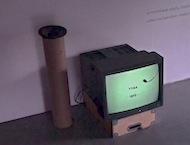 Related project: Concerto for TV Set and Diode for Voytek, a part of A Short History of Video Installations
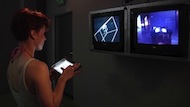 Related project: Framebox, a part of Alternating. Direct. Shifting. AC / DC / IT
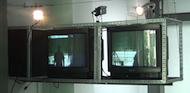 Related project: LIVE – Taped Video Staircase for Bruce Nauman, a part of A Short History of Video Installations
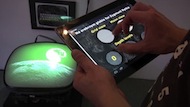 Related project: Na Srebrnym Globie (On the Silver Globe) for Zygmunt Rytka, a part of Alternating. Direct. Shifting. AC / DC / IT
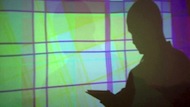 Related project: RGB: Ray Gun Beam Virus for Paul Sharits, a part of A Short History of Video Installations and Alternating. Direct. Shifting. AC / DC / IT
 Related project: Pierogi, a part of Alternating. Direct. Shifting. AC / DC / IT
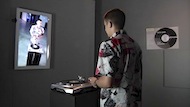 Related project: Vinyl Video Delay, a part of and Alternating. Direct. Shifting. AC / DC / IT
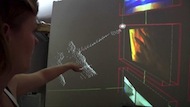 Related project: Vizzyx - Interactive Video Documentation Viewing Station, a part of A Short History of Video Installations and Alternating. Direct. Shifting. AC / DC / IT
 Read more about Alternating. Direct. Shifting. AC / DC / IT
 Read more about A Short History of Video Installations
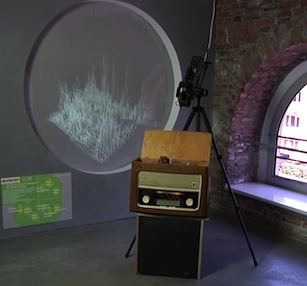 This piece, inspired by Woody Vasulka’s classic 1974 video C-Trend, is another installation in which the artist has manipulated the signal from a video camera. On the screen, instead of an ordinary camera image, is a “graphicized” image based on the technical parameters of the signal transmitted by the camera. This graphic representation of what the camera lens sees is modified by technical variables that aren’t normally visible on the screen. So the image we see is a representation of reality, although it’s completely different from our usual definition of a realistic image.